
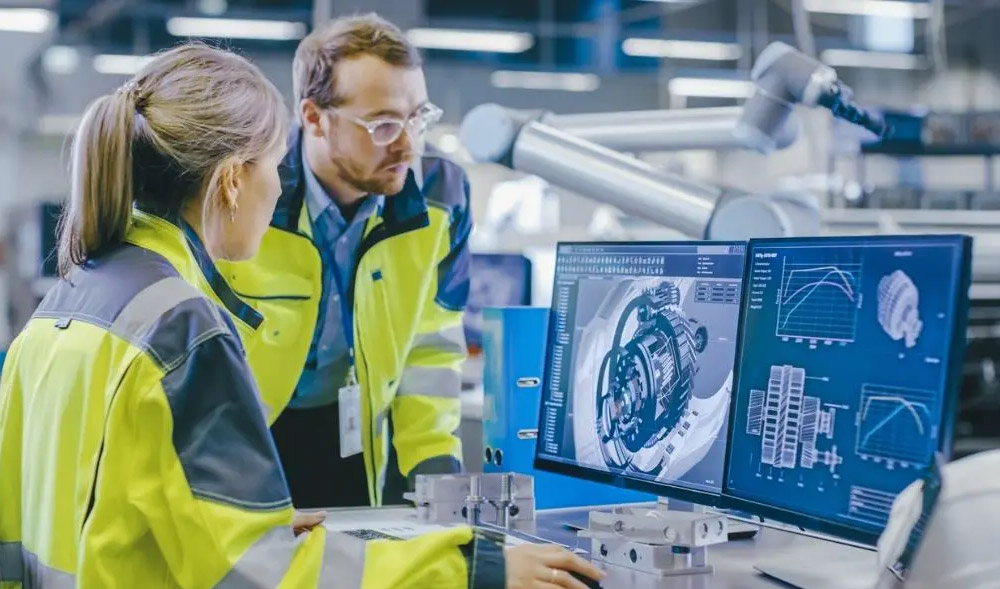
The manufacturing industry is on the verge of a data driven revolution. Companies are collaborating in hyperconnected value networks, using data and analytics applications to drive productivity, develop new customer experiences and improve the societal and environmental impact of companies.
This technological advance has come at a time of uncertainty. Climate change, supply chain disruption and conflict plague the global system — but the innovative use of data in manufacturing could be a stabilizing force for the global manufacturing industry.
From Data Collection to Insight
Manufacturers have long collected data—machine readings, production counts, defect rates—but much of it went unused or was analyzed only after problems occurred. Advances in sensors, Industrial Internet of Things (IIoT) devices, cloud computing, and analytics software have changed this equation. Today, manufacturers can capture real-time data from equipment, supply chains, and products themselves, then analyze it continuously to generate actionable insights.
This shift from historical reporting to real-time and predictive analytics enables manufacturers to move from “what happened?” to “why did it happen?” and, increasingly, “what will happen next?”
Types of Data in Manufacturing
Understanding the different types of data in manufacturing is crucial to choosing the right analysis techniques:
- Machine Data: Includes information from sensors, equipment logs, and operational metrics.
- Supply Chain Data: Tracks inventory levels, supplier performance, and logistics.
- Quality Assurance Data: Involves data from inspections, testing, and compliance reports.
- Customer Feedback: Gathers information from product reviews, returns, and satisfaction surveys.
Improving Operational Efficiency
One of the most immediate impacts of data analytics is improved operational efficiency. By analyzing production data, manufacturers can identify bottlenecks, optimize workflows, and reduce downtime. Analytics platforms can highlight inefficiencies that are invisible to the human eye, such as subtle variations in cycle times or energy usage across shifts or machines.
Predictive maintenance is a prime example. Instead of relying on fixed maintenance schedules or reacting to equipment failures, manufacturers use analytics to predict when a machine is likely to fail based on vibration, temperature, or performance trends. This reduces unplanned downtime, extends asset life, and lowers maintenance costs.
Learn more about CalSEA’s no-cost, customized employee training that will enhance your workers’ skill and make your business more competitive.
Enhancing Product Quality
Data analytics also plays a critical role in quality control. By correlating production parameters with defect rates, manufacturers can pinpoint the root causes of quality issues more quickly and accurately. Advanced analytics and machine learning models can detect anomalies in real time, allowing operators to intervene before defects propagate through an entire batch.
Over time, this data-driven approach leads to more consistent products, reduced scrap and rework, and higher customer satisfaction. In regulated industries such as aerospace, automotive, and medical devices, analytics also supports traceability and compliance by providing detailed, auditable production records.
Strengthening Supply Chain Resilience
Recent global disruptions have exposed vulnerabilities in manufacturing supply chains. Data analytics helps manufacturers respond by improving visibility and adaptability. By integrating data from suppliers, logistics providers, and market demand signals, manufacturers can better forecast demand, manage inventory, and identify risks early.
Advanced analytics enables scenario modeling—allowing companies to simulate the impact of supplier delays, material shortages, or demand spikes—and to make informed decisions about sourcing, production planning, and distribution. This capability is increasingly essential in an environment marked by volatility and uncertainty.
Enabling Mass Customization and Innovation
As customer expectations shift toward greater customization and faster delivery, data analytics enables manufacturers to respond without sacrificing efficiency. Analytics-driven production planning makes it possible to balance customization with scale, adjusting processes dynamically based on order data and capacity constraints.
Furthermore, insights derived from product usage data—especially in connected products—inform design improvements and innovation. Manufacturers can see how products perform in real-world conditions, identify unmet customer needs, and shorten the product development cycle.
Supporting Workforce Decision-Making
Data analytics does not replace human expertise; it enhances it. By presenting complex data in intuitive dashboards and visualizations, analytics tools empower operators, engineers, and managers to make better decisions. Workers can focus less on manual data collection and troubleshooting, and more on problem-solving and continuous improvement.
As a result, data literacy is becoming an increasingly important skill in manufacturing, reshaping workforce training and organizational culture.
The Road Ahead
The transformation of manufacturing—driven by data analytics—is still unfolding. As artificial intelligence, edge computing, and digital twins mature, manufacturers will gain even deeper insights and greater automation capabilities. However, realizing the full value of analytics requires more than technology—it demands data governance, cybersecurity, cross-functional collaboration, and a clear strategic vision.
Manufacturers that successfully embed data analytics into their operations are not just becoming more efficient; they are becoming more agile, innovative, and resilient. In an increasingly competitive global landscape, data-driven manufacturing is no longer a future aspiration—it is a present-day imperative.
About the CalSEA Alliance
The California Shipbuilding Ecosystems Alliance (CalSEA) is a new alliance of government agencies, industry, academic institutions, and nonprofits that support the US Navy’s efforts to strengthen America’s maritime industrial base.
By providing grant funded workforce development, supplier development and technology adoption and transfer, CalSEA will help California’s small and medium-sized manufactures increase production capacity, boost efficiency, and enhance technical capabilities.